
UK garden trends for 2026: the inside scoop from Britain’s leading designers
- Cedavi2
- Oct 4, 2025
- 5 min read
Updated: Dec 23, 2025
Forget what you think you know about British gardens
Forget what you think you know about British gardens. 2026 is about to shake things up in the most deliciously unexpected ways, especially across Kingston and the surrounding areas, where London style meets leafy suburbia and outdoor space truly counts.
These British garden design trends 2026 reflect a wider shift towards sustainability, craftsmanship and gardens that genuinely support everyday wellbeing, not just good photography.
British garden design trends 2026: what the pros are really saying
Let’s be honest. Whilst everyone’s been faffing about with last year’s tired trends, the UK’s leading garden designers have been quietly plotting a horticultural evolution. And frankly, it’s about time.
What’s emerging is not a set of gimmicks or Instagram tricks, but a more confident, thoughtful approach to outdoor space. One that balances beauty with climate reality, craftsmanship with comfort, and design with how people actually live.
“Strong beauty”, because pastels have had their day
Award-winning designer Jo Thompson, known for her elegant planting schemes and four Chelsea gold medals, has described 2026 as the year of “strong beauty”, a richer, braver use of colour.
Her Glasshouse Garden combined deep reds and burgundies with soft apricot tones, proving that bold colour can still feel harmonious and sophisticated.
Finally, someone embracing colour that doesn’t apologise for itself.
This marks a clear move away from washed-out palettes and safe planting. Gardens are becoming more expressive, more confident and, crucially, more memorable.
Tom Stuart-Smith’s naturalistic mastery (nine golds don’t lie)
When Tom Stuart-Smith, nine-time Chelsea gold winner and Royal Designer for Industry, talks about design, people listen.
His work is rooted in close observation of nature, balancing strong structure with softness and movement. From pleached Tilia to sculptural Buxus and layered perennial planting, his gardens blend modern formality with wild beauty.
His forthcoming Clore Garden for Tate Britain, due in 2026, is expected to showcase this sustainable, biodiverse ethos, proving that naturalistic planting can still feel refined, architectural and deeply intentional.
Mediterranean meets British, climate reality bites
Designer Baz Grainger, creator of the Killik & Co Futureproof Garden at Chelsea 2025, has been vocal about the need to adapt to a changing climate.
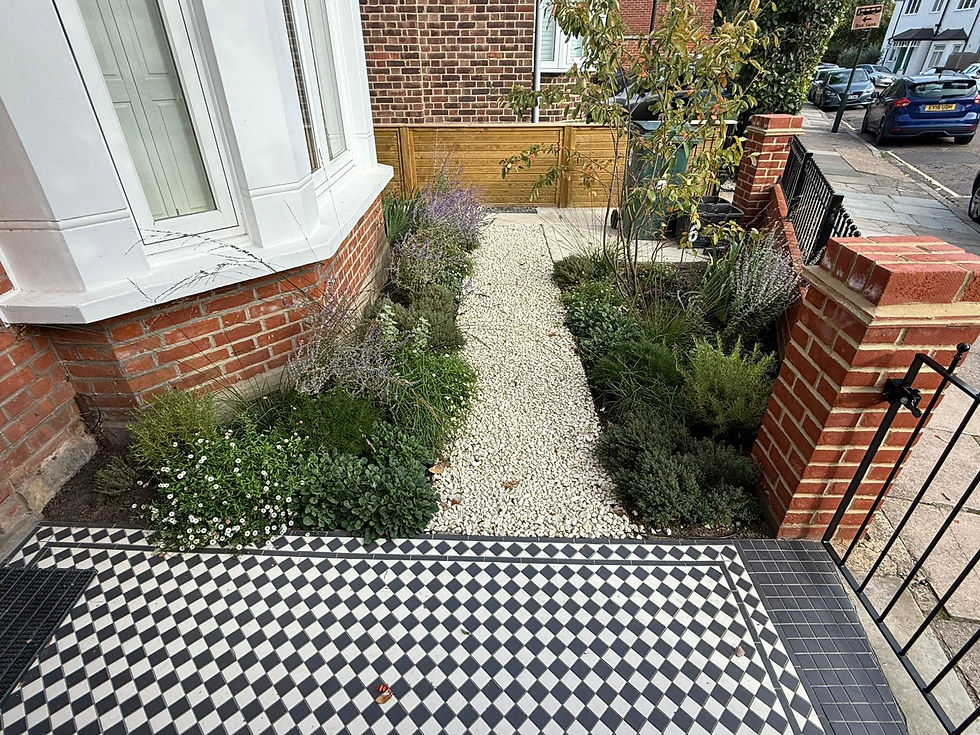
Hotter, drier summers and milder winters mean traditional “British sun” planting simply does not perform as reliably as it once did. Designers are increasingly looking to Mediterranean and drought-tolerant species that cope better with heat, fluctuating rainfall and poor soil conditions.
Craig Davis adds from the Flourish frontline:
“Baz is right. We’re already designing for it. Clients in Kingston, Surbiton and Hampton don’t want to replant every few years. Mediterranean plants are tough, elegant and save money in the long run.”
This is not about abandoning British gardens, but evolving them to suit the world we actually live in now.
Craftsmanship over mass production
Designer Eliza Gray has described a welcome shift away from one-size-fits-all landscaping towards bespoke craftsmanship.
Rather than catalogue layouts and off-the-shelf details, projects are becoming more site-specific. Paving layouts, step proportions, walling and joinery are designed to suit the garden, the house and how the space is used.
That’s music to our ears at Flourish. We have always believed that it is the invisible details that separate good gardens from unforgettable ones. Perfect corners, neat joints and considered finishes matter.
From townhouse courtyards in Teddington to riverside plots in Kingston, craftsmanship gives each garden its own personality and polish.
Natural stone’s triumphant return
According to Steve Walley of London Stone, natural stone is enjoying a well-deserved comeback after years of porcelain paving dominance.
Designers are rediscovering the depth, texture and warmth that stone brings, and pairing materials more creatively rather than relying on uniform finishes.
At Flourish, we couldn’t agree more. Natural stone has a timeless quality that porcelain simply cannot replicate. Whether restoring a period terrace in Hampton Hill or shaping a new family garden in New Malden, stone connects homes to their surroundings in a way that feels grounded and authentic.
Pergolas, essential not optional
Pergolas are no longer decorative extras. They have become essential for homeowners who want outdoor spaces that genuinely connect house and garden while coping with Britain’s unpredictable weather.
Louvred roofs, adjustable sides and integrated lighting are fast becoming the gold standard. They allow gardens to be used for longer, more comfortably and with far less reliance on temporary solutions.
Because no one enjoys a barbecue under a soggy gazebo.
Plant predictions that actually matter
Horticulturist Sarah Raven predicts that soft, romantic colours and textural planting will dominate in 2026.
Plants such as Verbascum ‘Southern Charm’, Stipa tenuissima and Linaria purpurea ‘Peachy’ offer gentle tones with strong structure and movement.
The Royal Horticultural Society also highlights naturalistic plant pairings that provide long-season interest, including Persicaria amplexicaulis, Aster and Molinia cultivars.
Sustainable beauty with minimal maintenance. What’s not to love.
Biophilic design, when everything comes together
After all the talk of colour, craft and climate, there is a bigger idea quietly tying it all together. Biophilic design.
This is not about jargon. It is about creating outdoor spaces that reconnect people with nature on every level.
From the tactile feel of hand-worked stone to the calming sway of ornamental grasses, from a pergola’s shifting shadow to the restorative rhythm of seasonal change, everything works together to support wellbeing.
Designer Catherine MacDonald often explores natural form and pattern to evoke calm and creativity, a principle running through many of today’s most successful gardens.
Craig Davis, Managing Director at Flourish Landscaping, explains:
“When design, planting and craftsmanship all align, that’s when a garden becomes genuinely restorative. It’s not about following a trend. It’s about creating spaces that help people live better every day.”
At Flourish, that philosophy underpins everything we build. From leafy Kingston gardens to compact plots in Surbiton, we see daily how thoughtful planting and careful construction transform everyday spaces into something restorative.
Biophilic design simply gives that feeling a name.
Gardens with purpose, beyond pretty pictures
Projects like Jo Thompson’s Glasshouse Garden, which supported women in prison through horticulture, have redefined what gardens can represent.
As James Scott from The Garden Company notes, there is growing emphasis on local materials, sustainable sourcing and immersive design that supports wellbeing and community benefit.
At last, gardens that give back socially, environmentally and emotionally.
Climate-conscious design, finally
The RHS’s recent predictions spotlight a growing appetite for edible and low-impact plants.
Think Vaccinium corymbosum (blueberries), Lonicera caerulea (honeyberries) and pollinator-friendly planting such as Salvia, Calluna and Dahlia cultivars.
Beautiful, productive and sustainable. Still wondering what’s not to love?
Front gardens and the EV revolution
With electric vehicles now a common feature of British driveways, front gardens are being redesigned for dual purpose.
Charging points are combined with permeable paving and resilient planting such as Geranium, Erigeron karvinskianusand Nepeta to manage rainwater and soften hard landscaping.
Smart, sustainable and unmistakably British.
The Flourish perspective, why this matters
At Flourish Landscaping, we are not trend-chasers. We are quietly leading the pack.
When Catherine MacDonald talks about biophilia, we are already there. When Tom Stuart-Smith champions naturalistic planting, we nod knowingly. It has been our approach for years.
What excites us most about 2026 is not prettier gardens. It is smarter ones. Spaces built on craftsmanship, sustainability and wellbeing, gardens that look sensational and genuinely make life better.
The bottom line
British garden design in 2026 is about evolution, not revolution. A confident balance of tradition, sustainability and style.
The designers who will thrive are those who understand that great gardens are not just for admiring. They are for living well.
At Flourish Landscaping, we have been creating those gardens all along, from Kingston to Hampton Wick, blending Chelsea-quality design with practical British sensibility.
Everyone else is finally catching up.


Comments