
Victorian front gardens
How to modernise a Victorian front garden without losing its character.
Victorian and Edwardian front gardens in Kingston and Surbiton were never meant to be decorative extras. They were carefully composed entrance spaces that set the tone for the house before you reached the door. Their defining feature was the path: a clear, confident line of geometric tiled paving or stone, framed by planting and boundaries that balanced openness with privacy.
When these paths and steps are reinstated with care, they do far more than improve kerb appeal. They restore the rhythm of the street, reconnect the house to its architectural roots, and make everyday arrivals feel considered rather than purely functional. Flourish Landscaping specialises in restoring these front gardens in a way that feels authentic to the period while working quietly for modern life.
What the originals were like
Victorian front gardens in Kingston and Surbiton followed clear, disciplined design rules. Paths were straight or deliberately aligned, boundaries were low to keep the street visually open, and planting was structured rather than loose. The materials, however, were where character and status were most clearly expressed.
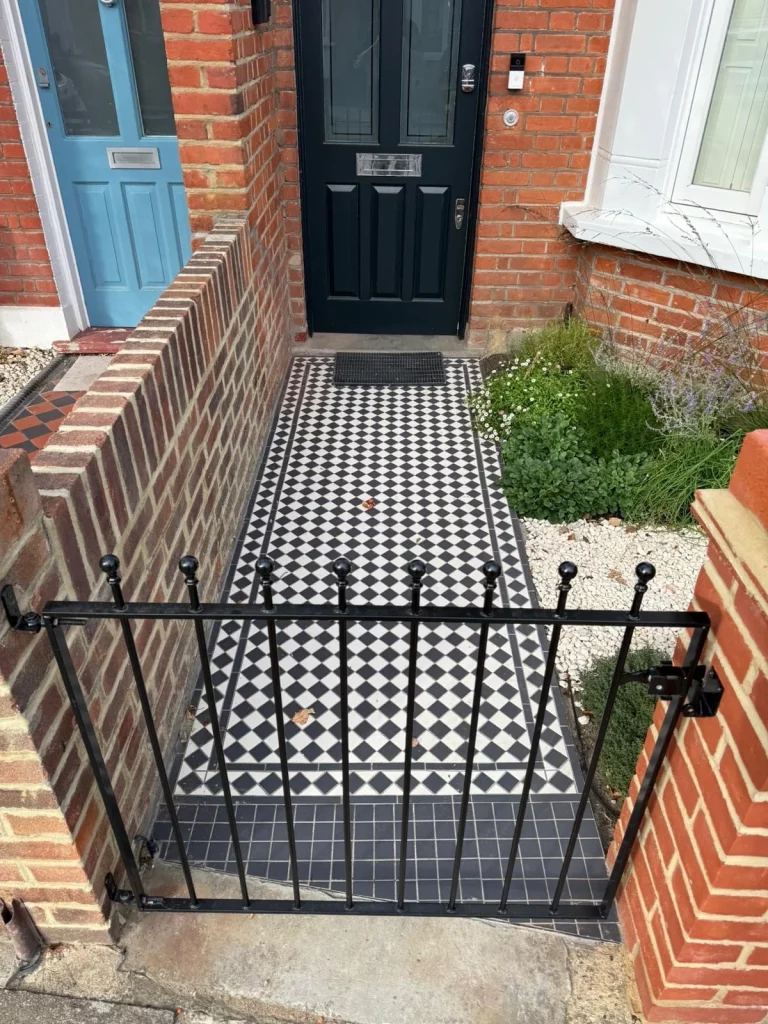
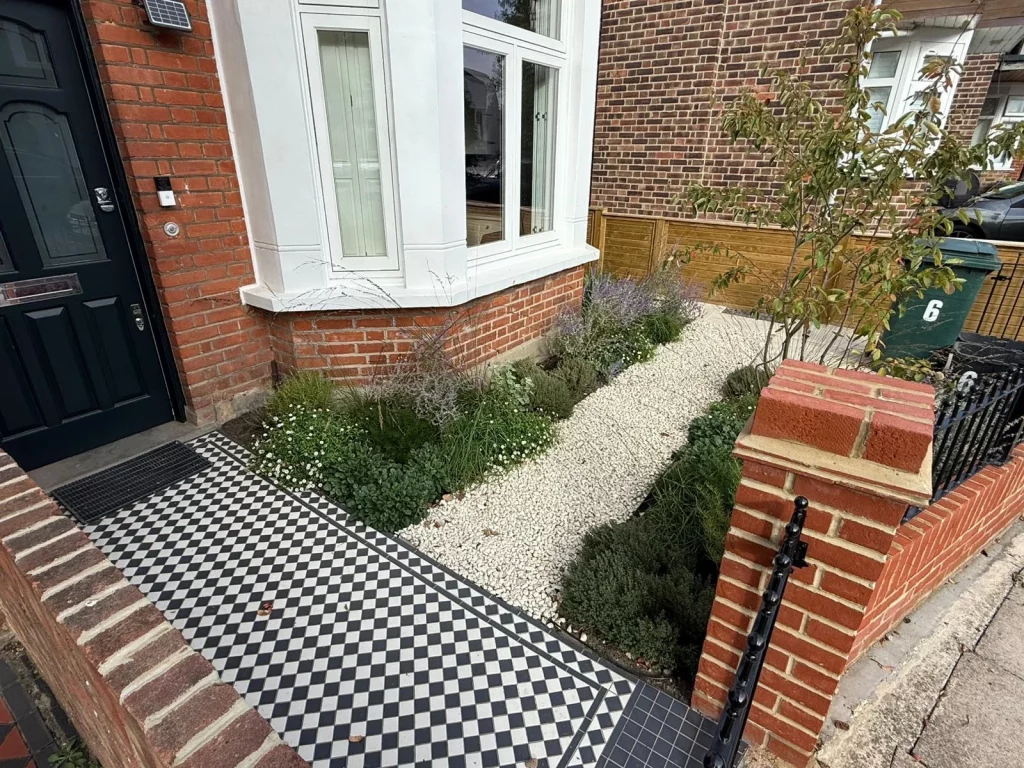
Geometric or encaustic tiled paths
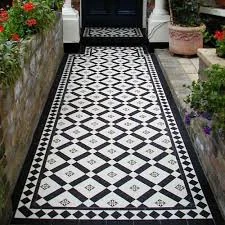
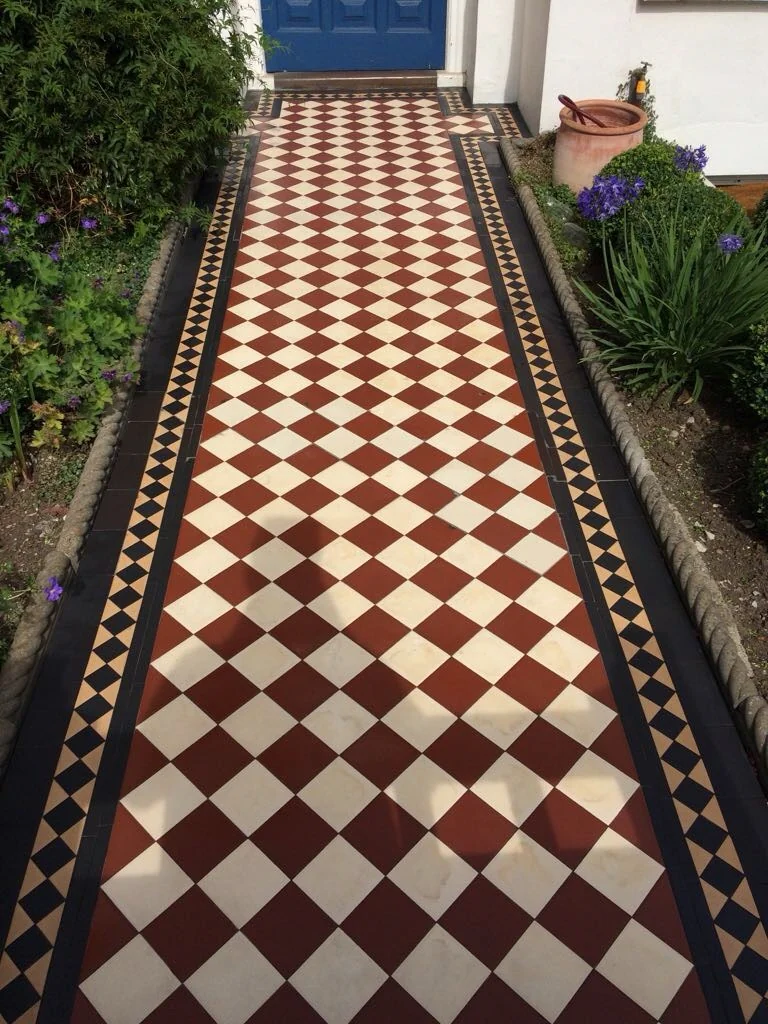
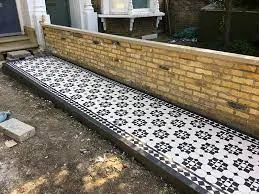
Traditional Victorian tiled paths were laid in strong repeating patterns with contrasting borders that framed the design. In this context, encaustic simply means patterned clay tiles where the design runs through the tile rather than sitting on the surface, making them extremely durable and well suited to outdoor use.
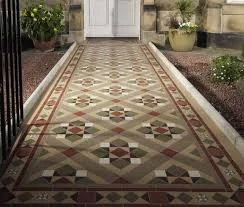
While black, white, terracotta, and buff are the colours most commonly associated with Victorian paths, many original paths were multicoloured. Deep reds, greens, ochres, and muted blues appeared in more intricate layouts. These richer patterns were more expensive and required skilled laying, so they quietly signalled confidence, taste, and financial comfort. On Kingston and Surbiton’s streets, a colourful tiled path was a deliberate statement made at the threshold.
York stone and Portland stone paths and steps
Alongside tiles, many houses used large-format York stone or Portland stone slabs for their paths. These materials created a calm, elegant approach and aged beautifully over time.
A key period detail was the use of bullnosed stone steps, which appeared in two important locations:
- At the boundary, where the private garden met the public footpath and changes in level needed to be resolved neatly
- At the front door, often with one or two deep steps that softened the rise and added a refined architectural finish
This bullnosed profile is one of the most distinctive details of Victorian entrances and one that Flourish carefully reinstates, matching proportions while improving modern safety and durability.

Clay knot (rope) edging
Another feature that sometimes survives is clay knot edging, also known as rope edging. This twisted clay border became popular in the late Victorian and Edwardian period as a decorative way to edge lawns and planting beds.
It was sometimes used alongside simpler tiled paths, particularly on smaller or more modest houses, but it was not usually paired with the most elaborate geometric designs found on higher-status villas. Today it divides opinion. Some homeowners enjoy its nostalgic charm, while others find it visually busy. Flourish treats it sensitively, retaining it where it genuinely adds character or replacing it with cleaner brick, stone, or metal edging for a more timeless finish.
Why reinstating a tiled or stone path transforms a front garden
Across Kingston and Surbiton, we see the same transformation time and again. Once a properly proportioned path and set of steps are reinstated, the entire frontage feels resolved.
The path restores structure. Victorian plots are compact, so strong lines matter. A well-aligned path anchors the garden and gives clarity, even when modern requirements such as storage or access are introduced.
The materials reconnect house and street. Tiles, York stone, and Portland stone have a permanence that modern paving rarely achieves. Restoring them brings coherence back to the façade and reinforces the building’s original presence.
Bullnosed steps complete the journey. Softened edges turn functional level changes into elegant transitions. A bullnosed step at the boundary followed by bullnosed entrance steps creates a dignified, welcoming approach that feels unmistakably period.
A restored Victorian path is not a decorative detail. It is the backbone of the front garden.
Modern needs, period style: the Flourish approach
Today’s front gardens have to work harder. Parking, bins, bikes, deliveries, lighting, and improved access all need to be considered, often within a very small footprint. Flourish specialises in integrating these modern needs without disturbing the period character.
Our approach typically includes:
- Engineered, permeable sub-bases beneath traditional tiles or stone to provide drainage and long-term stability
- Bespoke tile layouts designed around the proportions of the house rather than generic patterns
- Hand-finished bullnosed steps in York stone or Portland stone, crafted to suit the frontage
- Careful material transitions, such as tiles near the house and stone, clay pavers, or setts nearer the boundary
- Structured planting to soften hard materials and frame the path
- Discreet lighting, used sparingly and with purpose
Everything is designed to feel calm, intentional, and rooted in the building’s history.

A gentle approach to lighting
Victorian front gardens rarely need much lighting, and restraint almost always produces the most elegant result. These houses were designed to be appreciated in daylight, so lighting should simply support safe access and add a quiet sense of welcome.
For a small Victorian terrace or semi, one well-chosen wall light near the front door is often enough. Where there are changes in level, particularly around bullnosed stone steps, one or two discreet step or path lights can guide the way without drawing attention to themselves.
Occasionally, a single subtle uplight can be used to catch the shape of a small tree or clipped evergreen, but only where it genuinely adds something. Warm white light, simple fittings, and a limited number of sources always sit best. When done well, the lighting almost disappears during the day and gently supports the restored path, steps, and planting at night.
Style ideas for reinstating Victorian paths
Flourish regularly works with homeowners to choose an approach that suits both the house and the street.
- Classic black and white geometric tiles for terraces with strong architectural lines
- Terracotta and buff patterns for warmer, more relaxed cottage-style homes
- Full-width York stone paths with bullnosed steps for understated elegance
- Portland stone paths and entrance steps for a lighter, refined look
- Hybrid period–modern layouts, combining tiles near the door with stone or clay paving towards the gate
- Soft Victorian contemporary schemes, using restrained planting and a limited material palette
Each approach is adapted to the specific house rather than applied as a formula.
Why is Flourish Landscaping the authority on Victorian front gardens?
Flourish Landscaping is trusted across Kingston and Surbiton for restoring period front gardens with sensitivity and precision. Our work is guided by a deep understanding of Victorian proportions, materials, and craftsmanship, combined with modern construction standards.
We respect the architecture first, design with care, and build for longevity. The result is a front garden that feels right for the street, practical for everyday use, and quietly confident in its period character.
A Flourish front garden should look as though it has always belonged there, just carefully brought back to life.
Let’s create your perfect garden
Whether it’s a beautiful victorian garden with accompanying tiles, or something else you may have in mind, Flourish is the way forward, bringing skills in curating all kinds of gardens and designs, we are sure to work with you in creating something to be proud of.
Contact us today to arrange a consultation and start transforming your garden into the perfect outdoor space for you and your family.