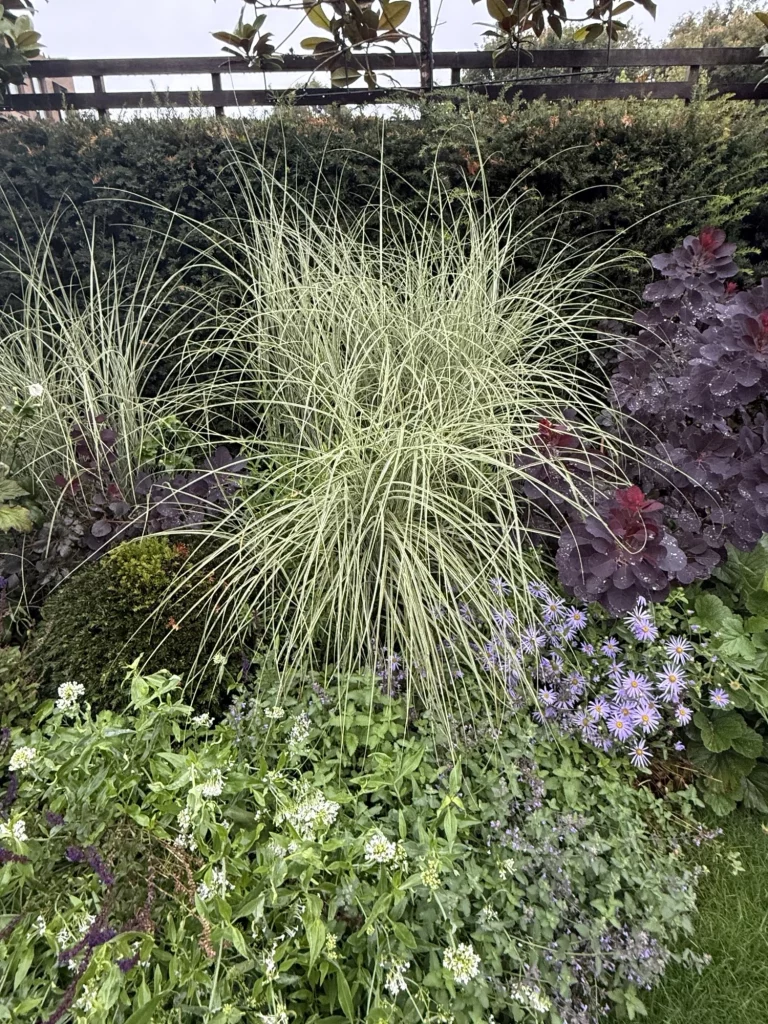
Evergreen structure
How to give your garden shape and structure all year round.
Evergreen structure is the quiet architecture of a garden. It is the backbone that stays standing through winter storms, summer heat and all the in-between months. When perennials retreat and grasses collapse, it is the evergreens that hold everything together and stop the garden feeling empty, a principle that matters especially in the mature, layered gardens we design across Kingston, Surbiton, Esher and Coombe.
People often ask “how many plants do I put in my garden?” and the honest answer is that the number matters far less than the balance. A very common mistake, especially among amateur gardeners, is to overlook evergreen plants completely or to treat them as an optional extra. Others add just one or two and hope for the best. The result is a garden that looks lively in summer but loses all shape and confidence in winter.
Evergreen plants are not background fillers. They are the structural bones of the space. When they are used well in a considered planting design, they give the garden its outline, its rhythm and its year-round identity. When they are used badly, or used too sparingly, the garden feels flat for half the year.
Why evergreen structure matters
Evergreen structure shapes a garden in three important ways.
- It anchors the layout. Evergreens give borders and paths a clear outline so the space feels intentional. This becomes even more visible in winter, when the shapes and lines of the garden are exposed.
- It provides rhythm and repetition. Repeating the same evergreen forms guides the eye through the garden and prevents borders from feeling scattered. Designers such as Tom Stuart-Smith and Dan Pearson consistently use repeated evergreen forms, clipped Taxus domes, drifts of Sarcococca, to create a sense of rhythm that holds a garden together through every season.
- It supports the garden in its off-season. Most gardens slump from November to March. Perennials vanish and deciduous shrubs lose their leaves. Evergreen structure keeps the garden standing through the quiet months, so it still feels cared for and intentional, important for the long winter views from Coombe and Esher homes that overlook substantial gardens.
How much of the garden should be evergreen?
A well-balanced garden usually works best with 30 to 40 per cent evergreen planting. This gives enough structure for clarity without losing softness or seasonality.
This proportion is supported by respected UK gardening sources:
- The RHS recommends that, in a mixed border, around a third of the shrubs should be evergreen or semi-evergreen to maintain structure through winter.
- The English Garden suggests around 40 per cent evergreen or winter-interest plants for a garden that looks good year-round.
- Hillier highlights that evergreens provide height, texture and a backdrop, especially when herbaceous plants die back.
A third evergreen is enough for clarity. More than that and you are designing formality; less and you are designing confusion.
Balance the evergreen structure well and the rest of the planting becomes easier. Perennials have shape to play against. Grasses gain contrast. Bulbs shine more brightly in late winter.
Evergreen percentage by garden style
Light and natural planting
20 to 25 per cent evergreen. Keeps borders open and soft while still maintaining shape. This is the proportion favoured in the naturalistic planting style.
Mixed borders
30 to 35 per cent evergreen. Ideal for most UK domestic gardens and modern planting styles, including the typical mixed borders we design for Kingston and Surbiton.
Contemporary gardens
35 to 40 per cent evergreen. Modern layouts rely on clear lines and repetition, which benefit from stronger evergreen structure. Common in newer-build properties around Esher and Hinchley Wood.
Formal gardens
40 to 50 per cent evergreen. Geometric layouts depend on evergreen reliability and shape, although varied foliage stops things feeling heavy. Suited to the period properties and listed gardens of Coombe and parts of Esher.
Quick practical guide
- Roughly one in every three plants should be evergreen.
- In a border of nine to twelve plants per square metre, three to five should be evergreen.
- Smaller gardens generally need more evergreen structure.
- Larger, looser gardens can use less, as long as shape remains clear.
Principles for good evergreen structure
Be intentional, not excessive
Use evergreens where structure is needed: corners, key sightlines, long border runs and points of visual rest. A simple placement rule: put evergreens where the eye naturally rests, not where you hope people won’t notice them. Structure should feel deliberate.
Mix forms, not just species
Strong structure comes from shape. Combine:
- Mounds
- Upright forms
- Loose natural shrubs
- Clipped cubes or domes
- Spreading ground-level evergreens
Match the garden style
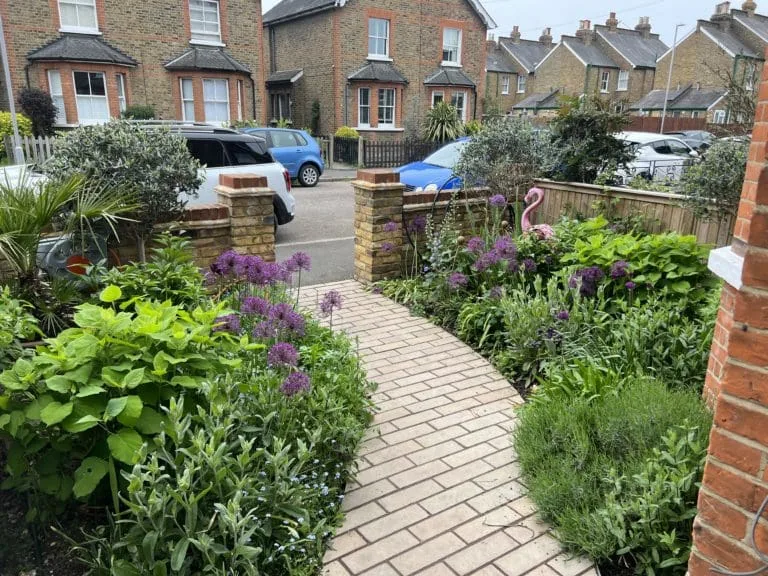
Cottage gardens prefer softer evergreens. Contemporary gardens suit crisp forms. Front gardens can take stronger structure for neatness, particularly the framed front gardens common on the Coombe estate, where evergreen structure carries much of the visual weight.
Think in layers
Evergreens should sit comfortably with:
- Deciduous shrubs
- Grasses
- Perennials
- Bulbs
This creates a balanced planting picture through all seasons.
Common pitfalls
- Overuse of large evergreens. Species such as Prunus laurocerasus or Griselinia littoralis can dominate a garden, blocking sightlines and casting dense shade. This often suppresses underplanting and reduces seasonal variation, leading to a flat, static appearance.
- Ignoring mature size. Plants chosen for their initial neatness, especially shrubs in containers, can rapidly outgrow their space. This results in overcrowding, increased maintenance, and the need for frequent pruning, which can distort natural form.
- Excess of dark foliage. Deep green foliage absorbs light and can make a space feel enclosed. Balancing this with lighter, variegated or silver-leaved plants such as Elaeagnus or Pittosporum improves contrast and visual depth.
- Neglecting winter light. In winter, low sun angles and shorter days amplify the heaviness of dark evergreen planting. Positioning lighter foliage or deciduous plants in shaded areas helps reflect light and maintain openness year-round.
- Insufficient repetition of evergreens. A single evergreen shape or specimen can feel disconnected. Repeating forms, heights or species establishes rhythm, structure and continuity across the space, especially in winter when other planting recedes.
Most gardens don’t fail because of the flowers. They fail because the structure beneath them is missing for half the year and chaotic for the other half.
The evergreen shortlist
Taxus baccata (yew)
Use: domes, hedges, cubes, formal structure. Pros: elegant appearance, slow-growing, extremely long-lived, excellent for shaping; holder of the RHS Award of Garden Merit and unmatched on heavy London Clay. Cons: toxic to livestock and pets if foliage is ingested.
Pittosporum tenuifolium (cultivars)
Use: soft mounding forms, informal structure. Pros: light foliage adds contrast; creates gentle rhythm in planting schemes; cultivars such as ‘Tom Thumb’ and ‘Golf Ball’ particularly useful. Cons: unsuitable for exposed or cold sites.
Osmanthus × burkwoodii
Use: compact evergreen structure. Pros: naturally neat habit; shade tolerant; highly scented spring flowers; ideal beneath the mature trees common in Coombe and Esher gardens. Cons: slow-growing, especially when young.
Elaeagnus × submacrophylla (formerly × ebbingei)
Use: screening and wind protection. Pros: very tough; bright foliage; strongly scented autumn flowers; useful for boundary screening on larger Coombe and Esher plots. Cons: needs space to develop; can become leggy if over-pruned.
Sarcococca confusa (Christmas box)
Use: structural planting in shade. Pros: evergreen; excellent winter scent that drifts on still days; reliable in low-light conditions; holder of the RHS Award of Garden Merit. Cons: slow but steady growth rate.
Viburnum tinus
Use: evergreen backdrop or boundary planting. Pros: winter and early spring flowers provide seasonal interest. Cons: leaves may develop spotting in wet or cold winters.
Euonymus japonicus ‘Green Spire’
Use: vertical accents and modern structure. Pros: slim, columnar habit; tidy growth; ideal for contemporary designs and increasingly recommended by the RHS as a box (Buxus) alternative. Cons: limited width reduces screening potential.
Prunus laurocerasus ‘Sofia’
Use: compact hedging or backdrop planting. Pros: lighter, denser habit than standard cherry laurel; avoids bulk and heaviness. Cons: still requires regular management.
Euphorbia characias and Euphorbia × martinii
Use: architectural evergreen highlights. Pros: strong structure; early flowering; excellent contrast with shrubs. Cons: short-lived; sap is a skin and eye irritant.
Euphorbia mellifera (honey spurge)
Use: feature evergreen plant. Pros: broad foliage; honey-scented spring flowers; strong architectural presence. Cons: requires shelter; dislikes hard frost.
If you only choose a few evergreen plants to give your garden shape, choose:
- Taxus baccata
- Pittosporum tenuifolium
- Osmanthus × burkwoodii
- Sarcococca confusa
- Elaeagnus × submacrophylla
- Prunus laurocerasus ‘Sofia’
- Euonymus japonicus ‘Green Spire’
- Euphorbia characias and Euphorbia × martinii
- Euphorbia mellifera
These provide a mix of height, texture, scent and reliability, and between them cover every brief we typically encounter across Kingston, Surbiton, Esher and Coombe.
Evergreen plants that did not make the shortlist
Buxus sempervirens (box)
Issues:
- Highly vulnerable to box blight (Calonectria pseudonaviculata, formerly Cylindrocladium buxicola) and box tree moth (Cydalima perspectalis), now widespread across south-west London including the KT postcodes
- Requires intensive maintenance to remain healthy and presentable
- Increasingly unreliable in long-term planting schemes; the RHS now recommends alternatives such as Ilex crenata and Euonymus japonicus for low clipped hedging
Standard cherry laurel (Prunus laurocerasus)
Issues:
- Excessively large and coarse for most garden settings
- Casts deep shade, suppressing surrounding plants
- Rapid growth can overwhelm borders and reduce design clarity
Inappropriate conifers
Issues:
- Many species, Cupressus × leylandii in particular, outgrow their intended space
- Difficult to combine successfully with perennials and mixed planting
- Dense form and colour can feel visually heavy in small gardens
Building a garden by pairing evergreens with other plants
Using evergreens with perennials and grasses
Evergreens bring stillness. Perennials and grasses bring movement. Together they create gardens that feel alive and structured.
Good combinations:
- Taxus domes with Calamagrostis × acutiflora ‘Karl Foerster’
- Pittosporum tenuifolium ‘Tom Thumb’ with Astrantia major
- Osmanthus × burkwoodii with Helleborus × hybridus
- Elaeagnus × submacrophylla with tall Miscanthus sinensis
Add bulbs
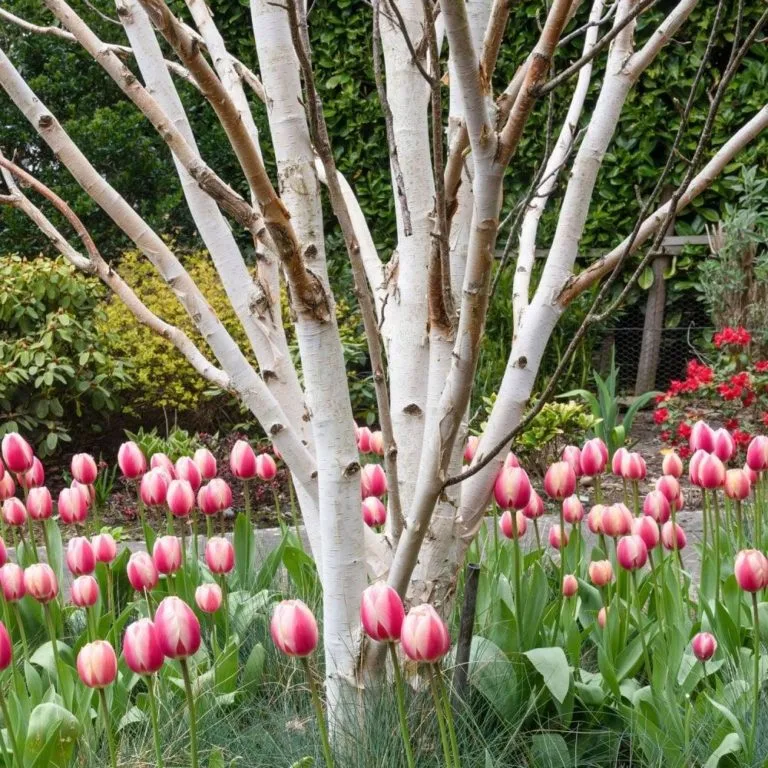
Galanthus, Crocus, Allium and Tulipa brighten winter and spring beneath an evergreen framework.
Planting and maintenance tips for Kingston, Surbiton, Esher and Coombe gardens
- Improve drainage before planting, essential on the London Clay typical of our area.
- Clip with intention, not out of habit.
- Water well in the first season.
- Replace failing plants quickly to protect the structure.
For gardens where ease of upkeep matters as much as design quality, evergreen structure also sits at the heart of a successful low-maintenance garden.
Let’s create your perfect garden
If you would like expert help with evergreen structure that holds your garden together every month of the year, get in touch. Flourish Landscaping designs, plants and maintains gardens across Kingston, Surbiton, Esher, Coombe and the surrounding KT postcodes, combining the design discipline of leading UK garden designers with the local knowledge that only comes from decades on these soils.
Contact us today to arrange a consultation and start transforming your garden into the perfect outdoor space for you and your family.